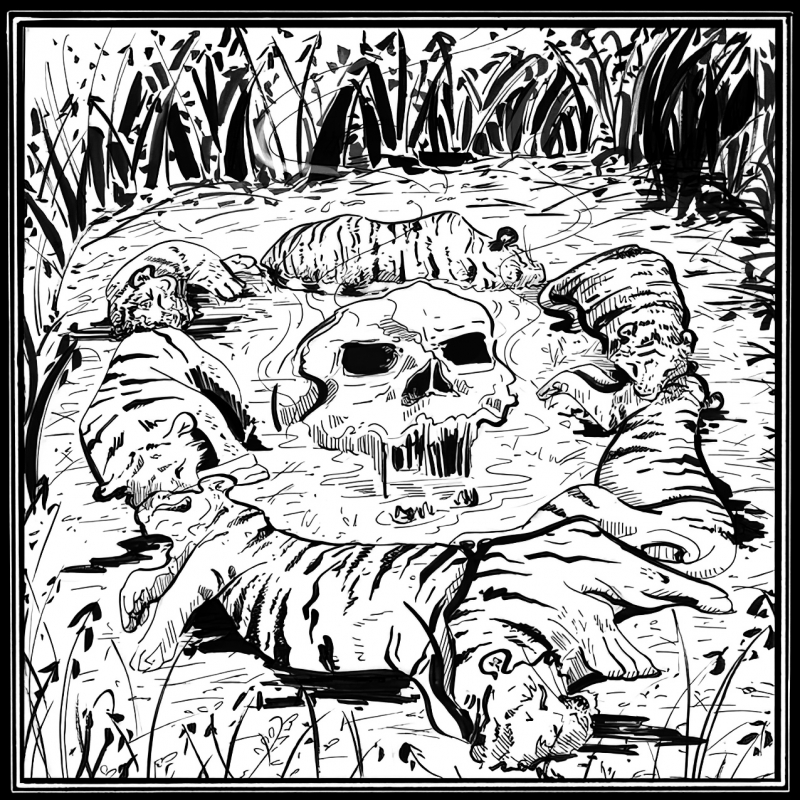
Airi haunts the dense and hilly jungles of Kumaon in Uttarakhand. He has a hideous face with eyes on top of his head. Some say he has four arms which carry different weapons; others say his arms themselves are bows and arrows.
Airi is said to be the ghost of a wealthy man and avid hunter who died while on shikar. He can be heard in the middle of the night crashing through the trees with his hunting party. Airi is carried aloft by his two ghostly litter-bearers, Sau and Bhau, who call out “Sau, sau” as they walk. He is also accompanied by his loyal ghost-hounds and a pair of Anchheri bodyguards with backwards-turned feet. Other attendant ghosts beat the bushes ahead of the palanquin to drive out the animals.
Airi is in the habit of spitting a lot. His saliva is extremely poisonous. If a glob of it lands on someone, that person is doomed to die within a few days unless healing rituals are performed.
Getting spat on is bad enough; but coming face to face with Airi is instantly fatal. The unlucky person who looks him in the eye will either be burnt to a pile of ashes or ripped into shreds by his ferocious dogs.
Ahmaw is a sort of vampire soul or jealousy demon found in the traditional belief of the Mara people, whose homeland is an autonomous district in the southeast corner of the state of Mizoram, on the border with Myanmar. This spirit can project itself from one body into another.
If a person is Ahmaw, he is perpetually envious. When he covets something that belongs to another — it might be fancy clothes, jewellery, or real estate — he sends part of his spirit inside the owner. This causes an excruciating stomach ache, so severe that it can be fatal if untreated. The affected person dreams of being chased by a horse or a dog, or of a leech crawling over his body.
When a person falls sick and the cause of the sickness is believed to be someone else’s Ahmaw, the victim’s relatives make offerings in order to satiate the spirit and drive it out of the afflicted person. If the sickness does not subside, the gifts become progressively more generous. First a large gourd-spoon full of food is offered; then a slaughtered chicken; then a slaughtered pig; then expensive jewellery; and finally a lick of human blood, drawn from the big toe of a loved one.
The head of someone who is Ahmaw can detach from the body at night*. The head goes rolling around into kitchens in search of meat to gobble up, or outside in search of livestock to kill. Some say the head can fly through the air in the form of a flickering flame. The head can also reduplicate itself; an Ahmaw may have as many as ten ghost-heads prowling for food. If all of these heads are captured and confined before they can roll back to rejoin the body at dawn, then the host body as well as the heads will die.
Aavi means “vapour” in Tamil. It is the word used for the steam from an idli cooker, the morning haze above a village lake, or the misty cloud of a person’s breath on a chilly night in the Nilgiris.
The word also signifies the vital spirit of a living thing: the sigh that leaves the body at the moment of death, to linger on as a ghost.
Most ghosts in Indian stories can take on a physical form. They disguise themselves as real, solid people that can be touched and felt. They can pick things up, wield weapons, do chores, eat food. They are often colourful: in cartoons and picture books, they’re drawn with bright blue or green or orange skin. They usually have fangs. When they aren’t in corporeal form, they either become invisible or transform into thick purple smog. They tend to be raucous and loud and vicious and bloodthirsty, whether or not they had that sort of a personality when they were alive.
The Aavi is an anomaly. In many ways it resembles the ghosts of Western stories more closely than Indian ones. It is wispy, white, forlorn, and brooding. It retains a lot of its personality from life, recalling its friends and loved ones as well as its enemies and its unfulfilled desires. Aavis can have only limited interaction with objects in the material plane, and they have a tendency to disappear into thin air when threatened.
Not to say that they can’t be scary. An Aavi might stretch its spectral arm through a wall, slowly moving its fingers as though grasping for something, sending any witnesses screaming away in terror. Or on a still and moonless night, its transparent head might roll out from underneath a cot, give a few anguished sobs, and then vanish.
Я с детства был страстным любителем страшных историй, дешевых романов ужасов и фильмов о монстрах. Ещё я люблю читать про индийский фольклор, особенно сказки о сверхъестественных созданиях. Издательство Blaft, которое двенадцать лет назад основал в том числе и я, добилось определённого успеха, выпуская литературу ужасов и книги о чудовищах — похоже, наши читатели, как и я, получают удовольствие от подобных историй.
Бхайрав и я взялись за составление этой книги по той причине, что хотя в Индии поразительное разнообразие мифологической нечисти, большая часть этой нечисти неизвестна за пределами конкретного региона или языковой общности. Такой расклад немного удивляет — обычно истории ужасов хорошо передаются между культурами.
Абайя (ориг. Abaya) — чудовище в игре Ведьмак 3: Дикая Охота.
Описание
Эта очень умная и опытная, а оттого – крайне опасная водная баба отличалась от своих сородичей размерами, силой и темным, более бирюзово-зеленоватым окрасом кожи без красных пятен. В своей пещере она отлично сосуществовала с утопцами, которые признавали ее силу и не пытались отвоевать территорию.
Игра «Ведьмак 3: Дикая Охота»
Геральт выполняет заказ на Абайю в гроте под скалистой грядой к юго-западу от порта у Каэр Трольде. Для того, чтобы обеспечить себе преимущество в бою с таким неприятным противником, ведьмак может изготовить зелье из феромонов утопца, чтобы эти существа не нападали на него, пока он будет сражаться с водной бабой.
Запись в бестиарии
Я много мерзости в сетях находил. Мурены, миноги, скаты… Но вот такого не видел!
— Бьорг, корабельщик из Каэр Трольде
Submitted by Monster Master on 10 сентября, 2021 - 17:46.
Крылатые твари-создания тёмного властелина Саурона которые использовались назгулами для полётов.
В текстах толкина сказано что Саурон выкормил их когда они были ещё птенцами до небывалых размеров.
Толкин описывает их как существ похожих на гигантских летучих мышей. С огромными перепончатыми крыльями и длинными шеями.
Зарегистрированные пользователи видят сайт без рекламы. А еще — добавляют комментарии без проверки, пишут в блог и на форуме, могут настраивать интерфейс сайта под себя.
Registered users see this site without ads, can add comments without pre-moderation, can write in the blog and on the forum, and can customize the site’s interface for themselves.
животное якобы из фольклора коренного населения Конго и Судана, схожее с европейским Единорогом
Сейчас с нами на сайте 0 users и 586 гостей.
Приветствуем новых пользователей: Horowitz, vamp, electronbyte, deartrmisss, Brruja.
Рекорд посещаемости был зафиксирован незримым летописцем бестиария в 23:04 11 сентября 2021 и составил 8942 человек (и представителей иных видов).
Все материалы, размещенные на сайте, являются интеллектуальной собственностью их авторов. Любая перепечатка допускается только со ссылкой на https://bestiary.us.
Коммерческое использование материалов с сайта без непосредственного разрешения правообладателей запрещено.
По вопросам сотрудничества и размещения рекламы обращайтесь по адресу kot@bestiary.us